 Donate
Final Salute
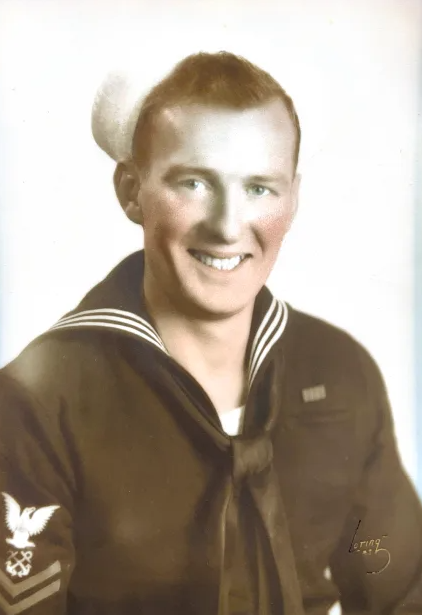
BM1c Frederick Hall
PO1/BM1c
During October, the 85th Lights for Peace flag flown at the Fort Taber–Fort Rodman Military Museum honors the memory of Boatswain’s Mate 1st Class (BM/1/C) Frederick Hall, who served in the U.S. Navy as a Seabee during World War II.
Frederick Hall, known as “Fred,” was born Jan. 17, 1912, in Manchester, England. He was the son of George Thomas Hall and Sarah Elisabeth (Jackson) Hall. The Hall family moved to the United States in 1912 aboard the SS Cymric. Frederick came from a family of nine children — eight boys and one girl.
Fred Hall came from a family with a long tradition of military service. According to his son, Rick, Fred’s father, George T. Hall, was a decorated World War I veteran. The family also made significant sacrifices during both world wars. Two of Fred’s older brothers were killed in action during World War I, and another brother was killed in action during World War II.
U.S. Navy Seabee Frederick Hall.
Military records confirm that Fred’s brother, Pvt. Edward Hall, was killed in action Sept. 27, 1918, while serving with the 15th Battalion of the Canadian Expeditionary Force during World War I.
After arriving in the United States from England, the Hall family settled in New Bedford. Frederick married Clarice Allison on April 23, 1934, at age 22. He was inducted into the U.S. Navy on July 12, 1943, and reported for duty in Boston. He was stationed at the U.S. Naval Construction Training Center at Camp Peary in Williamsburg, Virginia.
During World War II, BM/1/C Hall served in the 123rd Naval Construction Battalion as a salvage diver, performing vital, hazardous work in dark, debris-filled waters. His son, Rick, said his father was stationed on both Midway and Wake islands during his military career. Both areas “were vital strategic American outposts in the Pacific Theatre that became the sites of famous, fiercely contested battles,” according to the National Museum of the Pacific War.
Rick said that, as a Navy diver, his father dredged around the islands so ships could pass through. According to Wikipedia, Seabee divers performed numerous tasks, including removing coral reefs, sunken ships and downed aircraft with dynamite to reopen shipping lanes.
They also constructed and repaired piers, docks and bridges; patched holes in damaged hulls; and replaced propellers on damaged ships. Perhaps their most dangerous duty was removing or neutralizing unexploded bombs and torpedoes left behind by enemy attacks. Seabee divers were also responsible for recovering equipment, ordnance and the remains of fallen service members.
Frederick Hall was honorably discharged from the U.S. Navy on Nov. 1, 1945. He earned the Asiatic-Pacific Theatre Medal with one star, the Philippine Liberation Medal with two stars, the American Theater Medal and the World War II Victory Medal.
Frederick and his wife, Clarice, had two sons, George Frederick “Rick” Hall and Stephen Allison Hall. The family moved to Snipatuit Road in Rochester in the early 1960s.
Fred held many jobs throughout his life. Before entering the military, he worked as a tool-and-die maker, fisherman and salvage diver. After leaving the military, he purchased a fishing boat named the “Harvest” and worked as a fisherman while studying refrigeration part time.
After suffering a severe arm injury while fishing, he went to work for Aerovox, where he worked on printed circuits. He was later employed by Nu-Era Gear Manufacturing Co. in New Bedford. Rick said that, before retiring, his father also taught small-engine repair classes to inmates in Brockton.
Over the years, Hall was a member of VFW Post 6643 and attended several officer training courses at the Officer Training Institute from 1981 to 1983.
He was also involved in the U.S. Coast Guard Auxiliary, “the uniformed, all-volunteer civilian component of the United States Coast Guard” whose members act as nonmilitary, non-law-enforcement “force multipliers,” according to cgaux.org. Members use their own boats, aircraft and radio equipment, as well as Coast Guard assets, to assist with search and rescue, community boating safety and marine environmental protection.
Following the 9/11 attacks, his final year of service shifted from standard peacetime duties to intensive homeland security operations. He retired from the U.S. Coast Guard Auxiliary on Oct. 17, 2002.
Following his military service, Hall attended numerous reunions of the 123rd Naval Construction Battalion, including gatherings in Grand Rapids, Michigan; Columbus, Ohio; Niagara Falls, New York; and Itasca, Illinois.
Hall’s first wife, Clarice, died on Sept. 23, 1998. Years later, he moved to Dunnellon, Florida, where he married his second wife, Lee Hall.
Frederick Hall died on April 7, 2004, at age 92 and is buried at Florida National Cemetery in Bushnell, Florida. He was survived by his son, G. Frederick “Rick” Hall, and Rick’s wife, Cecelia Ann Hall, as well as Rick’s late wife, Teresa Ann, all of Rochester. He was also the father of the late Stephen A. Hall, whose wife was Margaret Hall.
Fred’s two sons followed in their father’s footsteps, continuing the family’s tradition of military service. Rick served in the U.S. Navy during the Cuban Missile Crisis, while Stephen served in the U.S. Marine Corps during the Vietnam War.
Linda Ferreira of Empire Ford researches the life stories of area residents, and Empire Ford provides the American flags. Staff at the Fort Taber–Fort Rodman Military Museum raise the flags. Those who would like to honor a local veteran in the future can contact Ferreira at [email protected].
This article originally appeared on Standard-Times: October Lights for Peace flag honors Navy Seabee Frederick Hall
If you would like to share an obituary of a loved one to be listed here, please contact the Navy Seabee Foundation at [email protected].